
DECEMBER 2025 SEASON
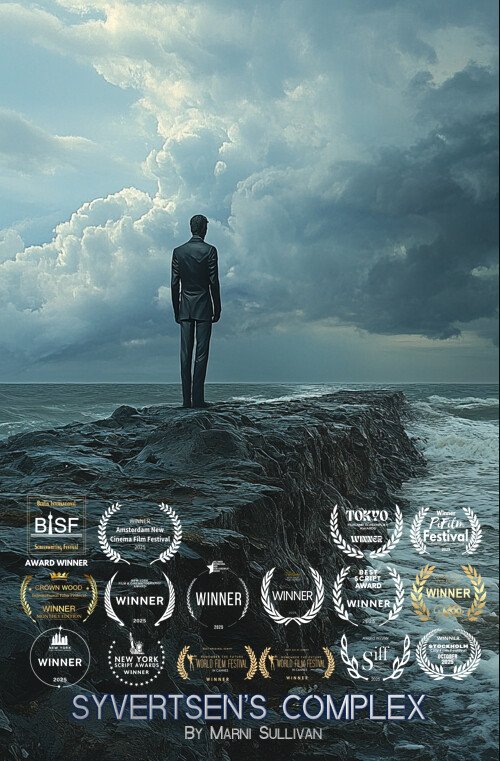
Title: SYVERTSEN’S COMPLEX
Writer: Marni Sullivan
Genre: Science Fiction Drama/Psychological Thriller
Page Count: 109 pages
AWARD WINNER – Best Feature Script
This is precisely the kind of bold, emotionally intelligent science fiction that restores one’s faith in the power of storytelling. Syvertsen’s Complex is a masterwork that seamlessly blends high-concept sci-fi with profound human drama, creating a narrative that is both intellectually stimulating and deeply affecting.
STORY & PLOT STRUCTURE
The screenplay constructs a brilliantly layered narrative around the concept of “praesidians” – bioengineered humans conditioned through neural bonding to serve as caregivers and protectors for wealthy children. What could have been a simple dystopian cautionary tale evolves into something far more nuanced: a meditation on grief, identity, autonomy, and what it means to choose one’s own life.
The plot structure is exemplary. The opening in medias res immediately establishes stakes and intrigue, while the non-linear storytelling – weaving between present action and memory sequences – creates mounting tension and emotional resonance. The writer demonstrates masterful control over pacing, knowing precisely when to reveal information and when to withhold it.
The central mystery – Rylan’s quest to find Dana Syvertsen, the only known survivor of his condition – provides excellent forward momentum while allowing for profound character exploration. The twist that Syvertsen has died is devastating but narratively perfect, forcing Rylan to confront his own agency rather than relying on external salvation.
THE TWIST & THEMATIC REVELATION
The screenplay’s most brilliant structural element is the gradual revelation of Rylan’s backstory. The memory suppression caused by the bonding protocol creates natural narrative tension, and the recovered memories hit with devastating impact.
The revelation that Rylan was once an orphaned child named Rylan Ingram – who lost his family in a car accident and was manipulated by Dr. Pritchard into the praesidian program – recontextualizes everything we’ve witnessed. This isn’t just about a man grieving his “charge”; it’s about a victim of institutionalized exploitation reclaiming his stolen identity.
The Pritchard scenes are chilling precisely because they’re so understated. This isn’t a mustache-twirling villain; it’s a predator who knows exactly which emotional buttons to press on a traumatized eight-year-old. The line “How would you like to have a little brother again, Rylan?” is genuinely horrifying in its calculated manipulation.
The final twist – that Dana Syvertsen is actually alive and living with her nephew Asger – is perfectly executed. Revealed only in the final moments, it suggests hope and continuation without undermining Rylan’s hard-won journey toward self-determination.
CHARACTER DEVELOPMENT
Rylan is an extraordinary protagonist. The writer captures his internal conflict with surgical precision – a man whose entire identity has been artificially constructed, now forced to build a new self from fragments. His arc from suicidal despair to choosing life, from conditioned servitude to genuine connection with Kirsi, is earned through every painful step.
The physical manifestations of his psychological trauma (tremors, convulsions, bleeding from the eyes) create visceral stakes while serving as perfect metaphors for repressed memory fighting to surface. His inability to speak about his bonding – the literal strangling sensation – is brilliant body-horror-as-psychology.
Kirsi Michalk is the screenplay’s secret weapon. She could have been a mere plot device or emotional catalyst, but instead she’s a fully realized character with her own arc. Abrasive, damaged, fiercely intelligent, and desperately seeking connection, she serves as both Rylan’s salvation and his mirror – another victim of systemic failure learning to trust again.The relationship between Rylan and Kirsi elevates the entire screenplay. Their dynamic crackles with authenticity – the bickering, the mutual protection, the gradual building of trust. The shopping scene is particularly lovely, showing care through action rather than declaration.
Dr. Stagner provides the perfect grounding presence – compassionate but clinical, pushing Rylan toward recovery while respecting his autonomy. Her line “You are a person, Rylan, not property” encapsulates the screenplay’s central thesis.Supporting characters like Brett and the Concierge are efficiently drawn, while antagonists like Theresa Holt are complex enough to avoid caricature – overworked and bitter rather than purely evil.
DIALOGUE
The dialogue is consistently excellent, balancing naturalism with thematic weight. The writer has a superb ear for how different characters speak:Rylan’s formal, precisely calibrated speech patterns reflect his conditioning while his gradual loosening (“Get your shit and let’s get the fuck out of here”) tracks his liberation.Kirsi’s profane, combative dialogue masks vulnerability and reads as authentically adolescent without becoming annoying.Pritchard’s manipulation is chillingly subtle, using questions and gentle suggestions rather than commands.
Standout exchanges:
Kirsi: “You’ll hang a bully by his neck for me, but won’t protect yourself?”This perfectly captures Rylan’s central dysfunction – he can only conceive of himself in relation to protecting others.
Rylan: “I cannot do it… No, I do not want to do it.”The distinction between “cannot” and “do not want to” is everything – the moment Rylan discovers his own will.
Young Rylan: “Will you join us?”
Pritchard: “Excellent choice, Rylan! You’re going to be the best and brightest yet.”The horror of a child signing away his autonomy, thinking he’s gaining a family.
WORLD-BUILDING
The screenplay creates a fully realized near-future America marked by extreme wealth inequality. The world-building is achieved through careful detail rather than exposition dumps:
The contrast between the “Ivory Towers” where Joel lived and the shabby decay of Ash Stone Cove
Technology that’s advanced (hydrogen fuel cells, holographic projectors) but unevenly distributed
The casual cruelty with which praesidians are treated outside elite circles
The dystopian Meadowview facility for juvenile offenders
The praesidian program itself is brilliantly conceived – just plausible enough to be terrifying. The bonding protocol, the insignia implant, the “ENGINEERED FOR PERFECT DEVOTION” branding – it’s consumerism meeting eugenics meeting emotional exploitation.
Denmark serves as effective contrast – a place where praesidians are illegal and Rylan can be treated with basic human dignity.
THEMATIC DEPTH
This screenplay tackles multiple intersecting themes with sophistication:
Autonomy vs. Conditioning: Can someone conditioned from childhood ever truly be free? The screenplay suggests yes, but only through painful reclamation of suppressed identity.
Grief and Moving On: Rylan must learn to grieve Joel while recognizing that his bond was artificially constructed. This doesn’t invalidate his feelings, but it means he can choose to move forward.
Class and Exploitation: The praesidian program literalizes how the wealthy consume the poor, buying orphaned children and reprogramming them for service.
Chosen Family vs. Imposed Family: Rylan’s relationship with Kirsi represents authentic connection based on mutual choice, contrasting with his bonded servitude to Joel’s family.
Memory and Identity: The recovered memories don’t erase who Rylan became, but they allow him to understand how he became that person and choose who he’ll be next.
The screenplay never preaches. Themes emerge organically through character and situation.
TECHNICAL EXECUTION
Scene Description: Vivid and efficient. The writer knows when to be sparse (“The doors slam open with a THUD”) and when to linger on significant detail (the insignia becoming inflamed when touched).
Visual Storytelling: Excellent use of POV shots to convey Rylan’s deteriorating mental state. The recurring nightmare images (the jetty, the broken glass, Theresa’s car) build toward the cliff scene with Hitchcockian precision.
Structure: The three-act structure is clear but not rigid. The midpoint turn in Denmark when they discover Syvertsen is dead lands exactly where it should.
Pacing: At 109 pages, the screenplay never drags. Each scene advances character or plot, often both simultaneously.
MARKETABILITY & PRODUCTION NOTES
This is eminently producible. While it requires some visual effects (the holographic displays, futuristic medical equipment), nothing is beyond reasonable budget. The emotional core is the real draw.The role of Rylan is a gift for an actor – a showcase that demands both physical intensity and emotional vulnerability. Kirsi is similarly rich, a breakout role for a young performer.The international locations (Denmark, Iceland teased for sequel) add production value while serving the story.
Comparable films: Never Let Me Go, Blade Runner 2049, Children of Men, Moon – cerebral sci-fi that uses high concept to explore fundamental human questions.
CONCLUSION
Syvertsen’s Complex is that rare screenplay that works on every level: as science fiction, as psychological drama, as social commentary, and as deeply human character study. It takes a high-concept premise and mines it for every ounce of emotional and intellectual resonance.The writer demonstrates complete command of the craft – structure, character, dialogue, theme, and visual storytelling all working in perfect concert. This is the kind of screenplay that reminds us why we fell in love with cinema in the first place.
RECOMMENDATION: ENTHUSIASTIC PASS FOR PRODUCTION
This screenplay deserves to be made, and made well. With the right director and cast, this could be one of the defining science fiction films of the decade – a film that makes audiences think, feel, and question systems of power and exploitation.Congratulations to the writer on a truly exceptional achievement.
Reviewed by: Jayoti M.
Chalchitra International Film Awards
Script Review Committee
December 2025
“A stunning meditation on identity, autonomy, and the choice to live on one’s own terms. Essential reading.”